

Things happen.
Inevitably, in work and in life, surprises come up.
And that happens no matter how much you’re wired to stick to the plan.
So how do you keep moving forward when unpredictability is a constant stressor?
First things first, you need to identify the issue.
Some people prefer to stick with the familiar. Others develop learned routines. But to understand the major factor at play here, it helps to know that there are three parts of the mind.
THE THREE PARTS OF THE MIND ARE
When you work in alignment with your conative strengths, tasks take less energy and effort. Things flow more smoothly. You get in “the zone.”
When you are forced to work against your conative strengths, tasks drain energy and things require more effort and focus, which can’t be sustained long-term.
George Boyd is a video editor by trade. He spent more than a decade editing for big companies like Meta and the NFL, but every time he landed the dream job it burned him out. So he left Los Angeles, moved to Texas, had a daughter, and started his own podcast agency to build a calmer, more predictable life.
Though George’s new setup is far more suited to his natural strengths, even now, chaos is a relative constant. George makes the plan, builds the system, and sticks to it. But there is always unpredictability that comes with working for different clients, and change is part of the process.
Inevitably, the day goes sideways, and he rebuilds it before anyone else notices. George has worried that means he’s too controlling. It really means he’s wired to keep things standing. And his family and clients depend on him for it.
George sat down with David Kolbe on the podcast Powered by Instinct: Private Sessions to go over his 6-7-2-6 Kolbe A™ Index result, and to get some actionable advice on how to use his natural strengths to keep things running at the level George expects without succumbing to the stress he dealt with so much in past roles.
Conatively, George is a CounterActing Quick Start, with a Natural Advantage™ of Chaos Controller.
That means he minimizes risk and uncertainty. He also Initiates in Follow Thru, which means his natural way of solving a problem starts with developing a system and a plan.
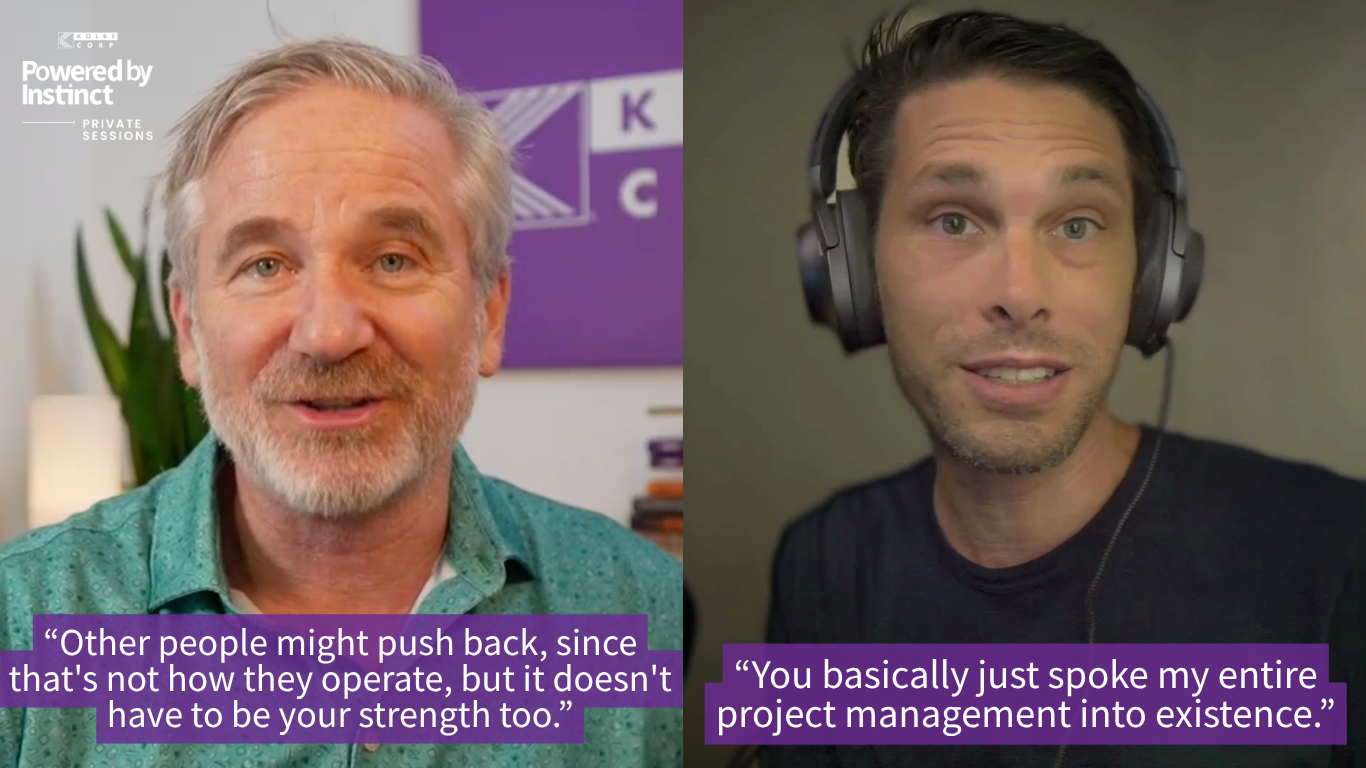
“You’ve got this wonderful strength,” David explained to George, “in getting in a situation where things can spin out of control and you really stabilize. You find what works. You stick with it. You find how to repeat that. Sometimes you will get pushback from other people, like, ‘Well, why don’t you just roll with it?’ Yeah, other people do that, but that’s not you.”
“When I think about my actions,” George responded, “it’s exactly me. Because not even 30 minutes before this call, I was just trying to make a decision of going with the flow with a client of mine or pushing to bring them into what I think is a better idea.”
George’s Natural Advantage shows up in several ways at his work.
“I think of myself as a bit of a shield,” he explained, “so that they can do their job better without knowing about, ‘Oh yeah, well, X, Y, and Z, this client is mad as a hornet.’ But you don’t need to know that. You need to know that the result’s this, and I’m going to try to keep you in that area where you don’t need all the context, but I’ll give you what you need to do a great job.”
One big tip David offered: plan for those chaotic moments. Expect them. And that way, you’re prepared. This resonated with George.
“There’s a lot of times,” George admitted, “when I get that deeply kind of panicky feeling in me and I’m like, ‘Oh, I’ve got to try to make sense of this or figure out how I can get back on track.’ And it is the unknown. And for me, it’s framing it as the unknown versus framing it as, like, the client did something stupid. It’s really just that I’m in a spot where there’s not a lot of clarity, and I think I need to be able to plan for that, sit with that, and not be very reactionary when that does come. And setting up a system for me to where I create space for that, which I don’t think I’ve been doing.”
“Yes,” David agreed. “Absolutely do that. Plan for it. Put chunks of time on the calendar. Put it in categories. One of the ways when you thrive as a chaos controller is realizing this isn’t chaotic. This is just a slight twist on that thing that happened two years ago or ten years ago. And then you can remind yourself, you’ve done this six times. And two of those weren’t so great. But four of them were awesome. It’s going to be awesome again.”


