

And students are often instructed to avoid leaving work to the last minute.
But procrastination is far from a flaw for many people, and for those who naturally work best when a plan breaks down and improvisation is needed, procrastination is often a very helpful and necessary tool.
Now, this is not good advice for everyone. Procrastination might be a real problem for you. To know the difference, you should take the Kolbe A™ Index and discover how you naturally operate.
You see, there are three parts of the mind, and most people only consider two of them. The three parts of the mind are cognitive (thinking), affective (feeling), and conative (doing). The conative part of the mind focused on natural, instinctive ways of taking action and creative problem-solving.
The Kolbe A measures your conative strengths across 4 Action Modes®:
Ava Ronchetti is a college student heading into her sophomore year at Liberty University. She’s majoring in national security and intelligence, killing it on the debate team, and looking forward to a future in law school.
She’s also a chronic procrastinator.
In fact, she once wrote a 20,000 word paper in just the final two weeks of class!
Now, to some, that may seem like an issue.
To David Kolbe, a leading authority on conation and human performance expert, it’s part of what helps Ava achieve so much.
Ava has an 8-1-7-6 Kolbe A Index result, and she learned more about those strengths on the Powered by Instinct: Private Sessions podcast.
On the podcast, David explained that Ava’s Natural Advantage™ is Multitasking Hero.
“You’re the kind of person that when the plan breaks down, you step up,” David offered. “ I would guess you work best when it comes to crunch time. You aren’t necessarily doing all the work right when the project starts. Maybe initially there’s kind of a flurry, but then you wait till the deadline is fast approaching. Is that true?
“Yes, that’s very true,” Ava responded, telling David about the 20,000 word paper.
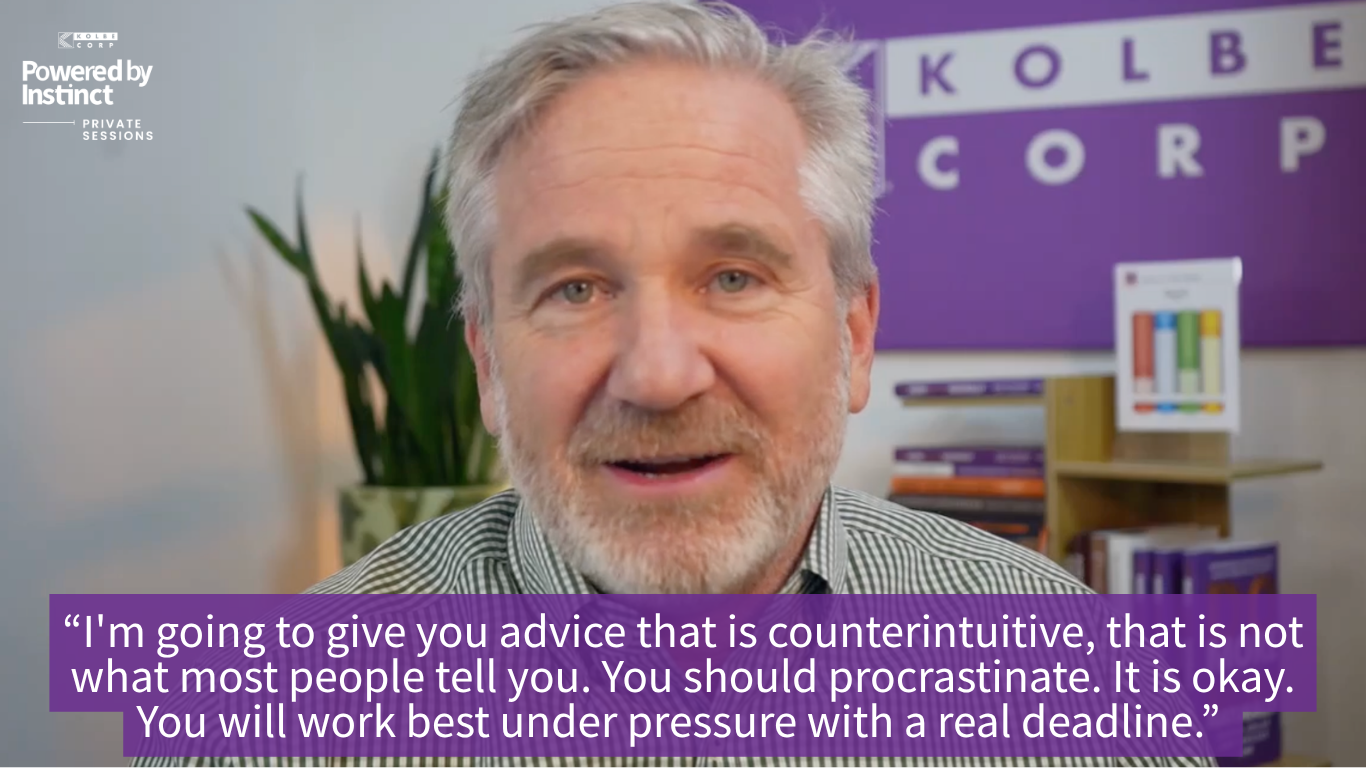
“I’m going to give you advice that is counterintuitive,” David countered, “that is not what most people tell you. You should procrastinate. It is okay. It’s not just okay. You will work best under pressure with a real deadline.”
Ava initiates by researching in-depth and also solves problems by innovating. She is a 1 in Follow Thru, which means she also has a strength for adapting. That means her natural approach may differ from some of her classmates or even some traditional expectations.
“Don’t buy into other people’s advice that you have to have it all planned out and systematic, like there’s one way to write a paper,” David advised. “You’re going be a little all over the board, and that’s okay. You won’t do your best work when you follow somebody else’s plan and system, and when you don’t give yourself the freedom to have a little more leeway and operating room to be open and adaptable.”
This is a common issue in education, where students are often told to follow specific rules or structures that may not align with their instinctive strengths.
For those like Ava, the key is to find clarity on their strengths and commit to them. It’s a necessary step for even the highest achievers, as studies show working against your natural strengths leads to an increase in stress, a decrease in productivity, and, ultimately, burnout.
For college students looking to avoid those pitfalls and take a strengths-based approach to their academic success and beyond, one essential tool is Kolbe Career Avantage™.
Career Advantage is an instinct-based career matching program built for high school and college students, as well as for early career professionals. It helps identify what they need from a career to be true to their natural way of taking action and connects them with careers that may fit.
It’s a great step to setting yourself up for long-term success, and to learn if procrastination is part of the problem, or part of your process.


